
Commercial service
Office cleaning that supports a professional, ready-to-work environment
Build a recurring or one-time office-cleaning plan around operating hours, employee traffic, public areas, and the way your workplace is used.
Workplace cleaning
A clean office depends on a consistent scope, not a generic checklist
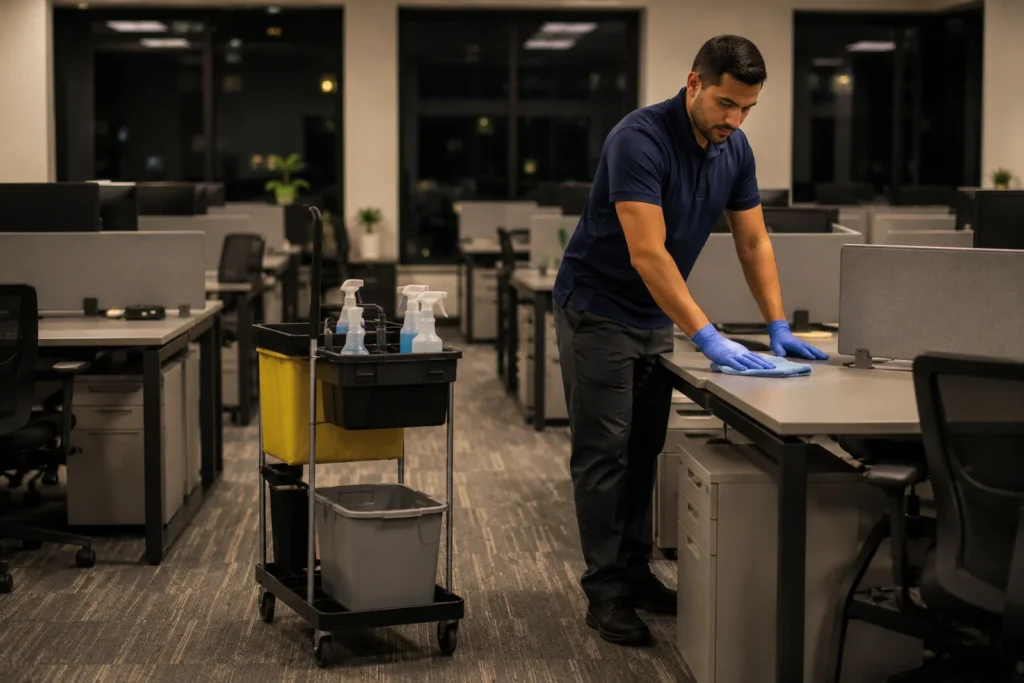
Office cleaning can include client-facing spaces, employee work areas, meeting rooms, breakrooms, restrooms, floors, and selected touchpoints. The right frequency depends on occupancy, operating hours, visitors, food areas, restroom use, and the appearance standard expected by the business.
A proposal should also clarify access, alarm procedures, keys, restricted rooms, parking, waste handling, and the person authorized to update instructions.
Where the property is a multi-tenant building rather than a single office, the plan also has to separate landlord-controlled common areas from tenant space, and name who approves changes. Both are settled in writing before the first visit.
DFW Clean HQ
Office areas commonly included
The final plan can prioritize daily-use areas and schedule lower-frequency detail tasks separately.
Reception and client areas
Entrances, reception desks, waiting areas, meeting rooms, and visible surfaces can be prioritized.
Workspaces and offices
Accessible desks, private offices, shared work areas, floors, and agreed touchpoints can be included.
Breakrooms and restrooms
Food-preparation areas, sinks, counters, appliance exteriors, restrooms, and supplies can be addressed as agreed.
Floors and rotation tasks
Vacuuming, mopping, interior glass, baseboards, vents, and other details can be assigned appropriate frequencies.
Multi-tenant buildings and common areas
Where a whole building rather than a single suite is in scope, landlord-controlled common areas — lobbies, corridors, elevators and shared restrooms — are quoted separately from tenant suites, and the boundary is written into the scope.
Scope of work
Office cleaning checklist: every visit, weekly, and monthly
A workable office scope separates what happens on every visit from what runs on a cycle. Both are documented so nothing is quietly dropped.
25documented tasks
Every visit
- 01 All waste and recycling collected and liners replaced
- 02 Restrooms fully cleaned, disinfected and restocked
- 03 Kitchen and breakroom surfaces, sink and appliance exteriors
- 04 Reception and entry glass spot-cleaned
- 05 Desks and accessible surfaces wiped where clear
- 06 Meeting rooms reset and surfaces cleaned
- 07 High-touch points disinfected: handles, switches, rails, lift buttons
- 08 All hard floors dust-mopped and spot-mopped
- 09 Carpeted areas vacuumed including traffic lanes
Weekly
- 01 Detailed restroom work including grout and fixture descaling
- 02 Full hard-floor mopping edge to edge
- 03 Interior glass and partition cleaning
- 04 Skirting boards and door frames wiped
- 05 Microwave and refrigerator exterior detailed
- 06 Chair bases, legs and castors wiped
- 07 Under-desk and edge vacuuming
- 08 Kitchen cabinet fronts cleaned
Monthly rotation
- 01 Vent and register covers dusted
- 02 High dusting: ledges, frames, light fittings
- 03 Blinds dusted
- 04 Refrigerator interior cleaned where agreed
- 05 Upholstered furniture vacuumed
- 06 Interior window sills and tracks
- 07 Detailed floor edge work and corner build-up
- 08 Storage, print and supply areas tidied and cleaned
Not included as standard. Rotation frequency is set per property. Interior window washing, carpet extraction, and hard-floor stripping are quoted separately as periodic project work.
A good fit for
Professional workplaces that need a repeatable service plan
- Corporate and administrative offices
- Small professional offices
- Coworking or shared-office environments
- Offices preparing for events, inspections, or occupancy changes
- Multi-tenant office buildings and property teams
- Law firms and professional practices with confidentiality requirements
Planning details
What helps us quote accurately
- Approximate square footage and employee or visitor traffic
- Operating hours and preferred cleaning window
- Number of restrooms, breakrooms, meeting rooms, and floor types
- Keys, alarms, restricted areas, parking, and waste procedures
- Which areas are landlord-controlled versus tenant-specific
- Who approves scope changes and receives service reports
Detailed service planning
What to consider before scheduling office cleaning
Useful cleaning content should help a customer make a decision, understand the process, and request a more accurate quote.
Restrooms and kitchens set the perception of the whole clean
Employees judge an office cleaning contract almost entirely on two rooms. A scope that spreads effort evenly across the floor plan tends to generate complaints, while one weighting restrooms and the kitchen higher — even at the cost of lower desk-area frequency — generally reads as a better clean.
Separate the nightly routine from the rotation
The most useful scope splits work into what happens every visit and what happens on a cycle. Vents, blinds, interior glass, baseboards, and appliance interiors do not need weekly attention, but they need a named interval, otherwise they are quietly never done and surface as a complaint six months in.
Tell your cleaner when the office changes
Headcount growth, a new floor, a shifted hybrid pattern, or a construction project all change the work required. Contracts that drift out of alignment with actual use are the ones that end badly — a short conversation when something changes is cheaper than renegotiating after service quality slips.
Commercial proposal
A cleaning plan built around your workplace
Commercial pricing is custom quoted based on square footage, frequency, traffic, service areas, access requirements, and the agreed scope.
-
Insured
General liability coverage in place. Certificates of insurance naming your ownership entity are issued before the first service date.
-
Background-checked cleaners
Every cleaner is background-checked before their first visit to a home or workplace.
-
Employees, not subcontractors
Our cleaners are hired, trained, and supervised by us, so the same standard applies on every job.
-
Written scope before service
The areas, priorities, price, and schedule are confirmed in writing before anyone arrives.
Frequently asked questions
Planning your cleaning service
How much does office cleaning cost per month in DFW?
Offices are quoted per site. The drivers are cleanable square footage, restroom count, kitchen or breakroom size, floor surface, headcount, and nights per week. Frequency moves the monthly figure far more than square footage does — going from two nights to five roughly doubles the labour, not the price per visit.
What is included in a standard office cleaning service?
Typically desks and accessible surfaces, meeting rooms, reception, kitchen and breakroom, restrooms, entry glass, waste and recycling, vacuuming and hard-floor care. Rotation items — vents, blinds, interior glass, baseboards, appliance interiors — are scheduled periodically rather than nightly and should be named in the scope.
How often should an office be professionally cleaned?
Most offices with daily occupancy run three to five nights a week, with restrooms and kitchens driving the higher end. Offices under roughly fifteen people or on hybrid schedules often work well at two or three. Restroom frequency is the figure worth getting right — it generates more complaints than anything else.
Do we need to provide cleaning supplies or equipment?
No. We bring equipment, chemicals, and cleaning consumables. Restroom paper goods, soap, and bin liners are usually supplied by the client, though we can carry them and bill at cost if you would rather not manage stock.
Can office cleaning happen after hours or at weekends?
Yes, and most offices prefer it. Evening service avoids vacuum noise during the working day and lets floor work dry overnight. We confirm access, alarm procedure, and lockup before the first unsupervised visit.
What is included in commercial cleaning for a multi-tenant office building?
A landlord scope typically covers lobbies, elevator lobbies and cabs, corridors, stairwells, shared restrooms, breakrooms, entry glass, and common-area floor care. Individual tenant suites are quoted separately, since each tenant sets its own hours, access rules, and standard.
Can you provide a certificate of insurance naming the property owner?
Yes. Send the exact ownership entity name and any additional-insured wording your management agreement requires, and the certificate is issued before the first service date rather than chased afterwards.
How do you protect confidential documents during cleaning?
Cleaners do not move, stack, read, or file paperwork. Desks are cleaned around whatever is on them. The reliable protection is a written exclusion list — documents, files, screens, whiteboards, restricted rooms — rather than relying on individual judgment late at night.
Do you clean server rooms, IT closets, or computer equipment?
No, unless specifically agreed and supervised. Server rooms and network closets are excluded by default. Monitors and keyboards are only cleaned if you ask for it in the scope, since equipment damage is a genuine risk and rarely worth taking on unrequested.
Can the cleaning scope scale as the firm grows?
Yes. Adding suites, meeting rooms, or a second floor adjusts the recurring scope rather than triggering a new agreement, and we reprice on the added space rather than reopening the whole contract.
Request a Custom Quote
Experience the DFW Clean HQ difference
Tell us how we can help. Share a few basic details and our team will follow up with a clear, personalized cleaning quote.
- Residential and commercial cleaning
- Flexible scheduling options
- No-obligation quote